


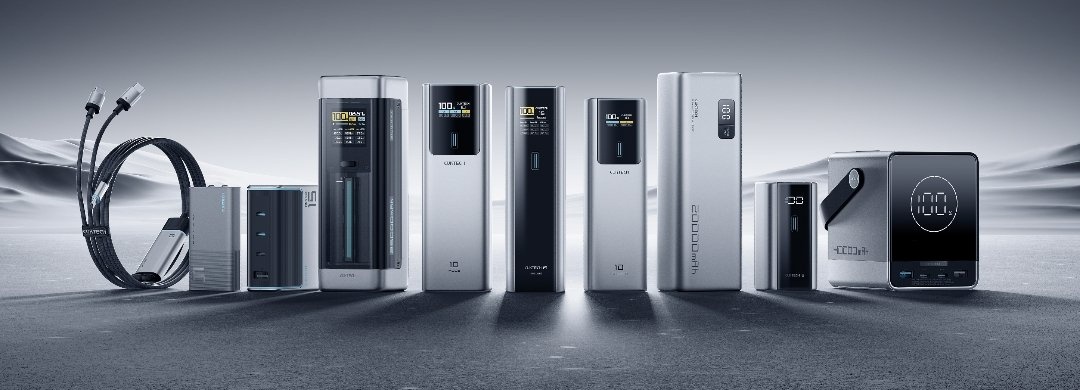
CUKTECH has confirmed a potential safety issue affecting its 10 Ultra GaN Charger (model AD1204U), after users reported cases of connected devices being damaged during charging. The company says the charger may, in extremely rare circumstances, fail to respond correctly to voltage negotiation requests, potentially exposing low-voltage accessories to an abnormal output of up to 20V.
CUKTECH has released a firmware update to address the issue. The fix was pushed through an over-the-air (OTA) update on November 18, 2026, and users are advised to install it through the Mi Home app.
What Is the Problem with the CUKTECH 10 Ultra?
The CUKTECH 10 Ultra is a multi-port GaN charger featuring an integrated display and a microcontroller (MCU) that manages charging protocols, power distribution, and display functions.
Under normal conditions, a USB-C charger communicates with a connected device to negotiate the appropriate voltage. For example, smaller accessories typically request 5V, while smartphones and laptops may request higher voltage levels depending on their charging requirements.
According to CUKTECH’s explanation, a protocol chip inside the 10 Ultra may occasionally become unresponsive. In this state, the USB-C port may fail to complete a new voltage negotiation and could remain at an output of up to 20V.
If a low-voltage device is connected while the port remains in this abnormal state, it may be exposed to excessive voltage, potentially causing damage.
Users have also described symptoms such as a frozen power display or a port that appears to have no output even though its voltage has not returned to zero.
User Reports Include Damaged Earbuds, Keyboards, and Other Devices
The issue attracted widespread attention after users began sharing charging-related damage reports on Chinese social media platforms.
One widely circulated Xiaohongshu post claimed that a CUKTECH 10 Ultra charger damaged the power management chip in an iPhone 16 Pro and subsequently caused problems with a Nintendo Switch 2.
Other users have reported damage involving accessories such as earbuds, keyboards, and mice.
These reports have also prompted discussions on Chinese technology forums and consumer complaint platforms. However, individual reports should not be treated as independently verified cases unless the damage and its connection to the charger have been established.
CUKTECH Confirms the Issue and Releases an OTA Fix
CUKTECH acknowledged that the 10 Ultra had a potential defect involving an unresponsive protocol chip.
The company says the issue has now been identified and addressed through a firmware update. The fix was released on November 18, 2026, and is designed to prevent the charger from maintaining an abnormal output of up to 20V when the protocol chip stops responding.
Users can install the update through the Mi Home app by connecting the charger via Bluetooth.
The update process requires the charger to restart and may take some time to complete. Users should follow the instructions displayed in the app and confirm that the update has finished successfully.
Disagreement Over When the First Damage Case Occurred
There are also differing accounts of when the problem first appeared.
Technology blogger Chaping Hardware Department (差评硬件部), citing industry sources, reported that the earliest known cases may date back to January 2026.
CUKTECH disputed that timeline, saying its first confirmed case involving user device damage occurred in June 2026.
The company explained that the number of early reports was too small for its engineering team to reproduce the problem reliably. It says the issue was only recently reproduced and its underlying failure mechanism identified, which delayed the firmware fix.
The blogger also reported that another manufacturer’s charger may use the same MCU and could potentially face a similar issue. However, the other manufacturer’s identity has not been disclosed, and no corresponding device-damage reports have been confirmed.
CUKTECH’s Response to Customer Compensation Claims
CUKTECH says it has completed assessments and compensation through its standard after-sales process for damage cases that have been verified.
However, following a sharp increase in online claims, the company says it needs to inspect individual damaged devices to establish whether the charger was responsible.
Some customers have reportedly been asked to provide formal diagnostic reports from qualified testing organizations as part of the assessment process. Other online accounts claim that replacement chargers were offered without compensation for the damaged connected devices. These individual experiences have not been independently verified.
What Should CUKTECH 10 Ultra Owners Do?
CUKTECH recommends that owners update their chargers as soon as possible. Users should take the following precautions:
- Install the firmware update: Open the Mi Home app, connect the CUKTECH 10 Ultra via Bluetooth, and check for the latest firmware under the device settings.
- Check for abnormal behavior: Watch for a frozen display, unusual voltage readings, or a port that appears inactive despite showing a non-zero voltage.
- Avoid charging sensitive accessories before updating: Until the firmware update has been successfully installed, it is prudent to avoid connecting low-voltage accessories such as earbuds, smartwatches, keyboards, mice, and handheld gaming devices.
- Disconnect the charger if abnormal behavior occurs: If the display freezes or the output appears abnormal, unplug the charger from the wall outlet before connecting another device.
- Keep evidence if damage occurs: Retain the charger, purchase receipt, customer-service correspondence, and repair or diagnostic documents to support an after-sales or compensation claim.
CUKTECH says devices designed to withstand 20V or higher are not affected by the specific fault. Nevertheless, owners should follow the company’s firmware update recommendation rather than relying on device compatibility alone.
The incident highlights the importance of firmware reliability in modern multi-port fast chargers. As charging products become more sophisticated, software and protocol-control failures can have consequences beyond charging performance.
(Via)